Showing posts with label Scenic Landmark. Show all posts

Thursday, September 10, 2015

Mariners' Playground sets sail for renovation

The Central Parks Conservancy is planning to overhaul their playground near the Mariners' Gate entrance, 85th Street and Central Park West.  Designed for 2-5 year olds, the playground renovation is part of the Conservancy's "Plan for Play" program and is the 7th of 16 planned projects under this initiative (the nearby Spector Playground for older children will be a future project).

The new, thoughtful design will provide for additional water play, perimeter play and circular seating, imaginative play, active play, manipulative play and the ever-popular swings.

Previously, Chris Nolan, the Conservancy's VP of Planning, Design and Construction presented their proposal to our LW! Certificate of Appropriateness Committee which opened a dialogue and gave community stake holders an early peek at the proposal in its working stages allowing them to provide their feedback.

We are pleased to report that this project was unanimously approved by the Public Design Commission yesterday. In the coming months, the existing playground will be dismantled and replaced by one with enhanced play opportunities and a more direct connection Robert Moses-era playgrounds of the 1930's and 1940's.

Please find a copy of Landmark West!'s testimony here

Tuesday, June 25, 2013

LW! Leads the Way for Grand Army Plaza Victory!


LANDMARK WEST! celebrates a victory in the proposed Grand Army Plaza restoration  that that was heard yesterday, June 24, at the Public Design Commission (PDC). The Central Park Conservancy’s plan to rehabilitate the plaza, an individual scenic landmark and signature work in the canon of the renowned Beaux Arts firm Carrère and Hastings, proposed an incomplete restoration that would amount to a hodgepodge of elements from different periods and represent an overall lack of vision.

Yesterday the Public Design Commission agreed with LW!’s point of view that Grand Army Plaza deserves a complete restoration, and story was covered on the front page of the art section in the New York Times today, June 25.

Although the Times picked up the story today, LANDMARK WEST! has lead advocacy efforts to fully restore the Plaza to the original Carrère and Hastings design since April 16, when the item first appeared before our Certificate of Appropriateness committee. We invited Charles Warren, an architect and Carrère and Hastings scholar and biographer, to that meeting, and it quickly became clear to the Committee that the CPC’s plan was incomplete.

Grand Army Plaza was initially slated for a Landmarks Preservation Commission (LPC) staff-level review with no opportunity for public input. LW! was informed on April 23, 2013 by the Central Park Conservancy that the LPC “reviewed GAP at staff level because the changes to the existing design we (sic) minimal.” LW! and others successfully advocated for the LPC to hold a public hearing on Grand Army Plaza.

In response to our outcry, LPC held a Public Hearing on May 21 during which testimony from nine individuals and organizations was heard. Although binding jurisdiction for the project was held by the PDC, the LPC advised continued study of the historic character of the plaza.

Upon learning of the calendared PDC hearing for June 24, LW! assembled a coalition of individuals and
organizations concerned with the fate of Grand Army Plaza and collected nearly twenty statements in support of a more complete restoration. This group of activists included Paul Goldberger, former architecture critic of the New York Times who reviewed the Plaza's last major rehabilitation in the 1990s, Samuel G. White, former partner in the Buttrick White & Burtis the firm who completed the 1990s work, Paul Gunther, president of the Institute of Classical Art and Architecture, the Historic Districts Council, as well as numerous neighbors and concerned citizens.

The Commissioners were moved by the testimony, and asked the CPC to come back with a more complete plan. As James Polshek, an architect and member of the commission said, “This is a piddling amount of money — nobody can claim the city is in a slump. We really shouldn’t settle for halfway. If it’s another five or six million, that’s not an adequate excuse.” Curbed agreed, calling the CPC on their "schtick." A definite victory!

Thursday, February 23, 2012

UPDATE: As historic Tavern on the Green re-emerges, new addition threatens to obscure once more

Earlier this month, we reported on plans moving forward for the iconic Tavern on the Green restaurant in Central Park.  Since then, the action has moved from the field to the hearing room.

The City's multi-agency team and contracted architects have shopped their proposal for what is being termed the "shell and core" restoration of the building before Community Boards (including the West Side's own CB7 Preservation Committee, on February 9th) and, on Tuesday, the Landmarks Preservation Commission (LPC).

Along with preservation colleagues like the Historic Districts Council (HDC) and Friends of the Upper East Side Historic Districts (connect with them here and here), LW! took to the podium before the LPC.  As we stated in testimony, "[t]he restoration of the Tavern on the Green to its former glory is an incredible contribution to the long history of this site." We're thrilled! Alas, "that restoration alone is not 'enough' and that an addition is also proposed is predictable" (copy our statement available here).

A glass pavilion has been proposed, to rise in the Tavern's Eastern courtyard, connecting to the historic building where once did the Crystal Room.  Curbed.com provided a glimpse of the final design for said pavilion, posting it to their site at almost the exact time that the LPC review commenced.

Proposed addition for the Tavern on the Green, via Curbed.com.
From LW's statement to the LPC:

LW! is not opposed to new design at the Tavern on the Green site in principle, but a legendary destination and a handsomely designed building such as this deserves something far more sympathetic; a quietly masterful note of our time. The pavilion proposed is a hefty glass-and-metal box that does nothing but hide what is most exciting about the building's primary facade: the East-facing central bay.

We're disappointed to report that the LPC ultimately approved the City's plan, glass box and all.

Read more from preservation advocates on this issue:
       - Statement of the Historic Districts Council (third project down, listed as "Item 9")
       - Statement of Friends of the Upper East Side Historic Districts

*Central Park, home to Tavern on the Green, was the City's first Scenic Landmark, designated by the LPC in 1974.  Learn more about the park and its history in the designation report. Up until now, and until work on the restoration begins, the Tavern on the Green building has served as a visitor's center (more here).

Wednesday, August 24, 2011

Diggin' Up the Dirt on Central Park's Past

REPORT from the FIELD
By Debi and intern Kate G.

This morning we visited the Institute for the Exploration of Seneca Village History’s Open House in Central Park.  The students' presentations were fascinating and ranged from the description of different nails found during the excavation, to the public's general knowledge of Seneca Village.  The entire Open House was a great reminder that no matter where you are in New York City, there are layers of history right beneath your feet!

Seneca Village Open House visitors learn about site findings, such as
19th Century "Tupperware" from students.

In the 1850s, Seneca Village, a thriving community with a population of nearly 300 people, existed on land between 81st and 89th Streets. This predominantly African American community was evicted and their land was taken through the right of eminent domain to make way for the construction of Central Park.

Victor A. Luna, a senior at City College, researched gender economics at Seneca Village.

This summer, the Institute (led by co-directors Cynthia Copeland, Nan Rothschild and Diana Wall) along with a crew of summer interns, conducted an archaeological excavation at the former site of Seneca Village. The Open House showcased the students' research and hosted walking tours of the site. Click here to see the New York Times' recent profile of the Institute's work.


The Seneca Village team excavated portions of a house built on the site.
Here, a visitor examines photos of what lies beneath.  The orange tape outlines
the foundations of the home.

Friday, August 19, 2011

Playtime in Central Park :: Playtime goes to the dogs, Part II

As West Side Rag wrote, "A project like this ... reminds people that landmarking is a way to hold on to things you care about."

We're thrilled at the positive reception our "Playtime in Central Park" photo series has had, and for the terrific participation from our friends and followers!  Already, you've seen Susy N.'s great photos of pups in the park.  Lucky for us--and for you!--we have more from her to share.  A great way to end the week, with a puppy serenade from Belvedere Castle (get it? 'cause they look like they're harmonizing in the chorus!).

Adorable yellow lab and American Eskimo puppies playing.
Belvedere Castle, 2001.

Having worked up a thirst, the "Adorable yellow lab and
American Eskimo puppies" enjoy some H20.
Belvedere Castle, 2001.

Susy & Michael's dog "Mika, a Rhodesian Ridgeback,
loved to go to the handball court and play ball".
The handball court in Central Park, 1997.
The blog series will continue for about another week, so start rummaging through your photo albums and boxes, see what memories you can turn up, and share them for publishing here!

Thursday, August 18, 2011

Playtime in Central Park :: Twilight reservoir run

Power to the tweeters!

Since announcing the launch of our "Playtime in Central Park" photo series (three weeks ago yesterday!) we've been delighted to see our friends and followers on Twitter (and their friends and followers in turn!) share photos and encourage others to contribute. 

You can imagine our delight when we saw a photo recommendation of the Central Park West skyline, so near and dear to our hearts, from former LW! intern and Pratt Institute HP grad Will Vogel (via Twitter).


Thanks, MacLovinNYC, for this beautiful shot of the skyline, reflected in the Jacqueline Kennedy Onassis Reservoir.  Two skylines are better than one!

The blog series continues.  Check out our submissions to date and send in your own photo(s).  New or old, all are welcome!

Wednesday, August 17, 2011

Landscape Architecture is "Designing Awesome"

Today via Twitter, LANDMARK WEST! learned about the American Society of Landscape Architects' (ASLA) pop-up signage project "Designed by a Landscape Architect".


Columbus Circle, NY. August 17, 2011.

The open, green spaces we enjoy--public plazas, college campuses, roof gardens, and more!--don't design themselves!  The pop-up signs, complete with QR codes to drive curious passersby to more info online, remind us of that.  LW's Cristiana and intern Kate G. scooted over to Columbus Circle this afternoon to check it out for themselves!

LW! has recently been at the front lines of advocating for the preservation and protection of a public concourse in Central Park, itself the product of thoughtful and successful landscape design: Cherry Hill.  As LW! and our preservation colleagues have testified before not one but two city agencies, Central Park--New York's first Scenic Landmark!--is all about layers! 

And the 1980s renovation and redesign of Cherry Hill by Gerald Allen (the paved concourse and fountain restoration) and Philip Winslow (the surrounding landscape) is a significant layer worthy of protection.  The 1980s is a momentous time in the life of Central Park as it was then that New York's urban oasis was rescued from its deleterious state and progressively restored to the urban green we know it to be today!


Kate G. uses her iPhone and the ASLA QR code to learn more.


LW! inspired someone else to check out the ASLA pop-up sign, too!


The northern edge of Columbus Circle.


Friday, August 12, 2011

Playtime in Central Park :: Row, row, row your boat

If it weren't for the outline of the distinguished Beresford Apartments on the horizon, you'd swear this photo was snapped in the wilds of upstate New York! 

LW's Cristiana Peña and intern Kate Gilmore snapped this photo, of boaters gliding across The Lake, on return from a site visit to the Cherry Hill Concourse (read more here ... and oh, is there more ...).


A relaxing visual note to take us into the weekend.  Add to that today's post by West Side Rag, encouraging readers to jump on our photo series bandwagon, and we're of the opinion that this day just can't get any better.  Loving summer in the city ... and especially on the Upper West Side!

Send in your photos -- past, present, you name it! -- and show us your moments at play in Central Park!

Friday, August 5, 2011

Playtime in Central Park :: Friday Fun, Part II

Rollerskating at the Naumburg Bandshell

Located just a stone's throw south of Bethesda Terrace is the mecca of roller and in-line skating: the Bandshell.  It seems fitting that the Park's principal formal element--the rectilinear promenade that is The Mall and Literary Walk, which the Bandshell connects with--would be the site of some of its most free-spirited recreation!


And for those seeking aural relaxation, catch one of the season's Naumburg Orchestral Concerts!  See?  Something for everybody. 

What are you favorite playtime memories in Central Park?  Tell us!  Join in the fun of sharing your photos, new and "vintage" alike!

Monday, August 1, 2011

Playtime in Central Park :: Splish, splash at Levin Playground

What's a toddler to do when the temperature hits triple digits?  Cool off in one of Central Park's playground fountains!  West Sider Robert I. captured this tot doing just that.


"I took this in the summer of 2007 in the playground to the north of the sail boat pond along 5th Avenue." ~~ Robert I.

The whimsical Sophie Loeb Fountain is the perfect backdrop for a bit of fun in Central Park.  Dedicated "In the Memory of Sophie Irene Loeb, Lover of Children--A Home for Every Child", the fountain features carvings of characters from the classic story "Alice in Wonderland".  A New York Times article covering the ribbon-cutting in 1936 described the fountain: "the King, the Queen, the Duchess, the Mad Hatter, Father William, the Pig Baby and the Frog Butler, and, of course, Alice, gaze down upon spouting water flowing from the mouths of minor 'Alice' characters into the large bowl."

Discover the Loeb Fountain for yourself!  The fountain, in the Levin Playground, is located at East 77th Street.  While you're out, use our playgrounds map to explore more of Central Park's play destinations.  And don't forget to snap a photo while you're there and send it in!

Friday, July 29, 2011

Playtime in Central Park :: Simple pleasures in the Sheep Meadow

Blogger and Upper West Sider Robin C., for her response to our call for submissions, features one of the Park's most popular destinations for recreation: the Sheep Meadow!  And to think, this used to be a common site!

"These three photos capture the simplicity of fun on a beautiful Easter day afternoon ..."   ~~ Robin C.


And in an act of shameless self-promotion may we add a final note from Robin C.:

"As a new resident of the Upper West Side, I so enjoy following Landmark West!"


Aw, we're blushing ...  Don't forget to check out photos from Rachel H. and Howard S. (not to mention Lila and Isabella!), too.  Then, it's your turn!  Forward your photos to lwlargefiles@gmail.com.  Be sure to include:

  • Your name
  • Location where the photo was taken
  • Year of the photo, if known
  • A brief caption of the memory the photo captures

Thursday, July 28, 2011

Playtime in Central Park :: Photos submissions begin to arrive!

First there was Rachel H., now Howard S. and his granddaughters are getting in on the Central Park photo fun!


"This is a picture of my then-8-year-old grandchildren, Lila and Isabella, taking a break from rowing, enjoying the small beach tucked away in a corner of Central Park's Lake."
~~ Howard S.

THANK YOU, Lila, Isabella and Howard!  Seeing your photo gives us the urge to drop what we're doing and scurry to the Lake, too!  Building sandcastles on a Thursday afternoon?  Why not?!

What are you waiting for?  Send in your photos for the "Playtime in Central Park" blog series today!  Here's how ...

Call for Submissions :: Share your favorite Central Park playtime photos!

LANDMARK WEST! invites YOU to show us the play spaces in Central Park that you love!  This photo-sharing project was born from the excited responses we received earlier this month to our email guide of the park's many playgrounds.  Not long after, we received a "vintage" photo from native New Yorker/current New Jersey denizen Rachel H., below.

So great!  We loved the idea so much--encouraging our friends and readers to share their photos of playtime in Central Park--that we've invited everyone to follow Rachel's lead, too!  Just forward your photo(s) to lwlargefiles@gmail.com with the following information:
  • Your name
  • Location where the photo was taken
  • Year of the photo, if known
  • A brief caption of the memory the photo captures

We can't wait to see YOUR photo!

Monday, July 25, 2011

(Re)Discover Riverside Drive :: Slide lecture on August 18th

LOST RIVERSIDE DRIVE

A History in Postcard Images
Slide Lecture and Book Signing


There was much hope and hype in the 1870s and 1880s that the Upper West Side would surpass Fifth Avenue in attracting the well-to-do in the area. A winding boulevard with vistas stretching for miles up and down the river, it was to become home to some of the private residences in New York City. This plan, however, was short lived, as aristocratic New Yorkers did not budge from their mansions on the East Side. Within a generation, the fancy homes and institutions built on Riverside Drive were engulfed in a dramatic redevelopment of the boulevard.

Please join LW! and vintage postcard collector Michael V. Susi (author of the Postcard History Series' The Upper West Side [2009], and Columbia University and Morningside Heights [2007] from Arcadia Publishing) for a rare glimpse into his personal collection depicting the majestic Riverside Drive.

Thursday, August 18th, 2011 at 6:00PM

Macaulay Honors College
35 West 67th Street

**SPACE IS LIMITED**

Tickets are $25
Reservations are Required


Call 212-496-8110 or email landmarkwest@landmarkwest.org

Thursday, July 14, 2011

Public Art in Riverside Park

DID YOU KNOW: The monument dedicated to Joan of Arc in Riverside Park (at West 91st Street) was the first public sculpture in New York City dedicated to a non-fictional woman.

DID YOU KNOW: The position of repose in which the woman rests at the Ida Straus memorial, in Straus Park, is almost physically impossible to mimic.  At the very least, it sure isn't comfortable!


Michele Bogart welcomes the group at the Soldiers & Sailors Monument.

Yesterday evening, friends of LANDMARK WEST! gathered in Riverside Park to tour a selection of monuments and memorials.  Led by Jean Parker Phifer and Michele Bogart, the group of curious urban explorers discovered the lesser-known details of five works of public art:


Soldiers & Sailors Monument.

Soldiers & Sailors Monument
, Riverside Park at West 89th Street
Sculptor: Paul E. Duboy
Architect: Charles & Arthur Stoughton

The tour explores the Soldiers and Sailors Monument.

Michele Bogart discusses the Joan of Arc Memorial.

Joan of Arc Memorial*, Riverside Park at West 91st Street
Sculptor: Anna Vaughn Hyatt Huntington
Architect: John V. Van Pelt

From the Joan of Arc Memorial.


Jean Parker Phifer discusses the Joan of Arc sculpture.


The tour takes in the Firemen's Memorial
on approach westward from within Riverside Park

Firemens' Memorial
, Riverside Park at West 100th Street
Architect: Harold Van Buren Magonigle

Firemens' Memorial.


Bas relief at the Firemens' Memorial.


Sculptural grotesque from the Firemens' Memorial.
General Franz Sigel, Riverside Drive at West 106th Street
Sculptor: Karl Bitter
Architect: William Welles Bosworth

Straus Park, between Broadway and West End Avenue at West 106th Street

*For additional information on the Joan of Arc Memorial, check out this DNA Info article featuring West Sider Valerie Thaler.

Monday, July 11, 2011

Playful Design is Serious Fun in Central Park!


Summer Is Here In A Big Way,
So Get Out And Play! 
  
Recreation and play are serious art forms in Central Park! To help you plan your summer play, LANDMARK WEST! brings you a map paired with a few facts about the Central Park playgrounds! Learn about these creative play spaces - a full listing follows - but first, some of LW's favorites designed by renowned architect and lfUD fellow Richard Dattner (Follow Dattner Architects on Twitter!).  


HECKSCHER PLAYGROUND - #1 (Find it on the map below!)

The Heckscher Playground originally opened in 1926, and is named for its founder August Heckscher Sr., grandfather of August Heckscher III who served as Parks Commissioner under Mayor John V. Lindsay. The playground is both the largest (roughly 3 acres) and the oldest in Central Park, and is the only playground that is not located around the park's perimeter. Heckscher Playground is located at approximately 62nd Street at 7th Avenue, slightly west of the center of Central Park. The playground recently underwent a $6 million renovation/redesign and reopened to the public on May 12, 2006. It is located in one of the three locations originally designated for play in Frederick Law Olmsted and Calvert Vaux's initial 1858 Greensward Plan for Central Park. If you're a kickball fanatic, this the place you want to be!   


ADVENTURE PLAYGROUND - #3  

Opened in 1967 the Adventure Playground was built by Robert Moses after the famous dispute surrounding a plan to create more parking for the privately-owned Tavern on the Green restaurant in Central Park at West 67th Street (now a visitor's center). The was the first of the "adventure playgrounds" designed by Mr. Dattner for Central Park. Born out of the World War II era, the adventure playground philosophy is that children would create play areas out of found materials, or debris. For this reason, they were sometimes also known as "junk" playgrounds.  Adventure playgrounds (our preferred name) encourage children to create their own play environments using their imaginations by utilizing tools and movable objects.  When controversial renovation plans for the playground arose in the late 1990s, LANDMARK WEST!, Friends of the Adventure Playground, and other members of the neighborhood met with Dattner, ultimately resulting in proposals for  the redesign. As landscape architect and city planner Michael Gotkin wrote in his essay The Politics of Play, "The Central Park Adventure Playground was a pivotal work of landscape design and survives as perhaps the most important extant modern playground in America."
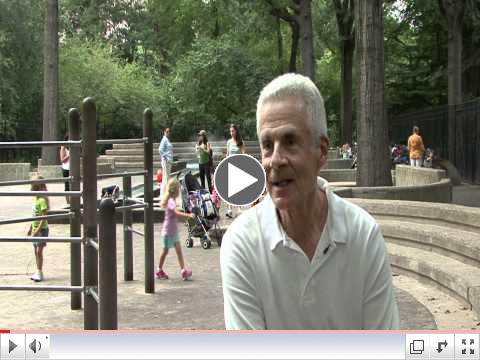
Landmark West! Interviews Richard Dattner
Landmark West! interviewed Richard Dattner. Click to view.

Watch LW's interview with Richard Dattner as he discusses the history of the Adventure Playground by clicking the image. 

Afterward, check out more of the great interviews that LANDMARK WEST! has done with prominent figures of New York City architecture. 

The Institute for Urban Design (@IfUD) tweeted a great way to learn why Dattner's early design work continues to spark discussion.   


EAST 72ND STREET PLAYGROUND - #5

This playground features tire swings, wooden climbing structures, sand, a stone slide, a water tower, and a net "spider web" for climbing. It is situated adjacent to the East Green. Generally a busy playground, the East 72nd Street Playground is an excellent playground for older children because of its many interactive play features. 


ANCIENT PLAYGROUND (aka - Ancient Play Garden) - #12 

Mr. Dattner designed this playground with the Egyptian art of the neighboring Metropolitan Museum of Art in mind. The spray shower in the park is analogous to the African nation's Nile River. Other references to ancient Egypt include obelisks that allude to Cleopatra's Needle, climbing pyramids that reflect the Temple of Dendur, a vast sand area representing the Egyptian landscape, and a sundial.  The Ancient Playground is located just to the north of the Museum, at 85th Street. The playground underwent a renovation in 2009, and as part of that effort the Osborn Gates by Paul Manship (built 1953, removed 1972 due to vandalism) were restored.


WILD WEST PLAYGROUND - #15

You guessed it! This almost-entirely-wood playground was designed to resemble a frontier town.  Featuring the key ingredients of children's play, a water "river" runs through it, allowing children to build sand castles and to cool off in the summer. The Wild West Playground is near Central Park's Tennis House (the focus of an LW! advocacy campaign) between 94th and 96th Street.

______________________________________________________________
 PlaygroundMap
POP QUIZ!  The Question... 

According to Robert Moses, why are nearly all of the playgrounds in Central park located near entrances, along the perimeter of the park? See the answer after the maps below!

______________________________________________________________
  
Let this map help you navigate your summer fun in the playgrounds of Central Park.  


And for a little extra enjoyment, see where the Central Park Playgrounds fall on a map of Central Park from 1875, long before the playgrounds existed as we know them today. Full listing, below.

Historic map of Central Park with Current Playgrounds marked out
Hinrichs' 1875 Guide Map of the Central Park with the modern parks marked out in red. Click to enlarge.
PlaygroundMapKey

 Playgrounds on the Map
  1. Heckscher Playgroundat 59th Street at 7th Avenue   
  2. Tots Playgroundat West 67th Street 
  3. Adventure Playgroundat West 67th Street  
  4. Billy Johnson Playgroundat East 66th Street 
  5. East 72nd Street Playgroundat East 72nd Street  
  6. James Michael Levin Playgroundat East 77th Street  
  7. Pat Hoffman Friedman - Three Bears Playgroundat East 80th Street 
  8. Diana Ross Playground,  at West 81st/82nd Street 
  9. Mariners' Playgroundat West 85th Street 
  10. Abraham and Joseph Spector Playgroundat West 86th Street 
  11. Arthur Ross Pinetum Playgroundat West 85th Street 
  12. Ancient Playgroundat East 85th Street 
  13. East 96th Street Playgroundat East 96th Street 
  14. Safari Playgroundat West 91st Street 
  15. Wild West Playground at West 93rd Street 
  16. Rudin Family Playground,  at West 96th Street 
  17. Tarr Family Playground,  at West 100th Street 
  18. Robert Bendheim Playground, at East 100th Street 
  19. Bernard Family Playground, at East 108th Street
  20. Lenox Avenue Playground, at 110th Street at Lenox Avenue
  21. West 110th Street Playground, at West 110th Street  


POP QUIZ - The Answer is...

"Located near the major entrances, [the playgrounds] intercept children on the way into the park and provide a place in which excess energy can be worked of without damage to the park surroundings."
-Robert Moses 


  iPhoneAppBEAT THE HEAT!  
Stay inside and still explore the
Upper West Side
One of the twin towers of the San Remo Apartments. 145-146 CPW. Built: 1929-1930. Architect: Emery Roth.
   

Download the
FREE LANDMARK WEST WALKING TOUR app and access photos and facts about historic neighborhood buildings, all from the comfort of your home
   
of the LANDMARK WEST! Walking Tour app
for iPhone/iPad/iPod Touch, today!

IMAGE AT LEFT:
The southern tower of the San Remo Apartments, as seen from Central Park.
145-146 Central Park West, between W. 74th St. and W. 75th St.
Built: 1929-1930.
Architect: Emery Roth.


Follow LANDMARK WEST on Twitter!Be LANDMARK WEST's friend on Facebook!View LANDMARK WEST's photo albums on FlickrView LANDMARK WEST's videos on YouTube!